

You already have a tarot deck. You’ve learned its rhythms, pulled cards when a situation felt tangled, and maybe built a practice around asking better questions. Then you see an oracle deck that catches your eye, and a quieter question comes up:
Do I actually need this, or am I being upsold?
Here’s the honest answer: you don’t need an oracle deck if you already have tarot. Tarot can support a rich, complete practice on its own. An oracle deck isn’t a requirement, a replacement, or a beginner’s version of tarot.
But the right oracle deck can do a different job. The question isn’t whether you need more cards. It’s whether another tool would bring useful structure to the way you reflect.
What tarot is built to show
A traditional tarot deck has a defined 78-card architecture: 22 Major Arcana cards and 56 Minor Arcana cards organized into four suits. That shared framework gives tarot a consistent symbolic language to learn and return to.
In a reading, that structure can help you look at the shape of a situation: what’s moving, where tension is building, what resources are available, and what choices or patterns deserve attention. A spread gives you positions to consider, while the cards offer different angles on the question.
That’s why tarot can be especially useful when you want to explore a situation in layers. A three-card spread, for instance, might help you reflect on the context, the challenge, and a possible next step. The cards don’t decide for you; they give your attention something specific to examine.
For tarot for beginners, the shared architecture can take time to learn, but that’s also part of its value. As you become familiar with the structure, you can work with different tarot decks while carrying much of the same foundation with you.
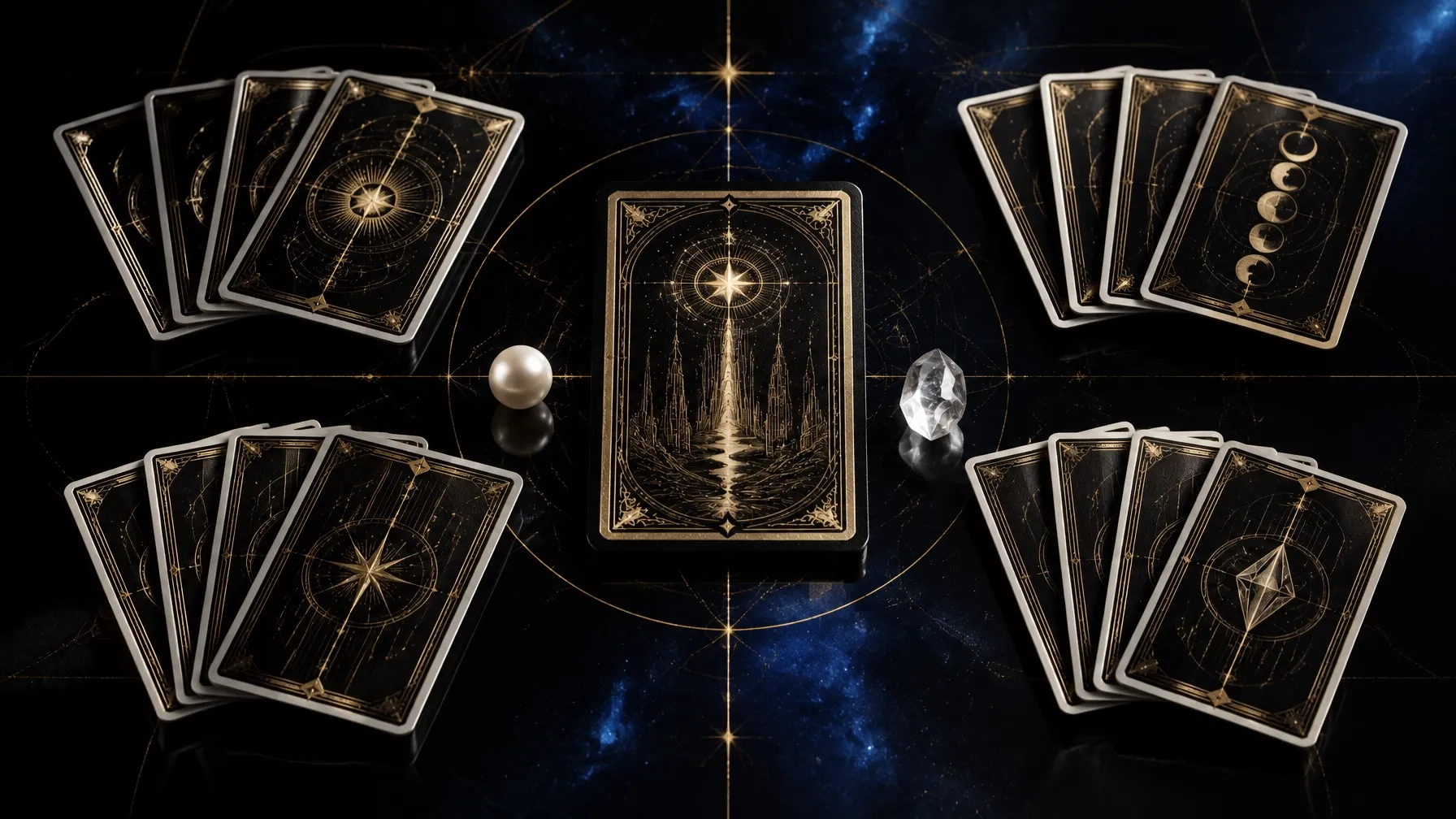
What an oracle deck is built to show
Oracle decks don’t follow one universal card count or system. Their creators define the structure, themes, and meanings. One deck may offer affirmations; another may focus on emotions, archetypes, relationships, or a particular symbolic world.
That doesn’t make oracle cards watered-down tarot. It means an oracle deck can be designed around a different question.
The Mystical Realms Oracle Deck is a 44-card system built as an 11-by-4 matrix: the same 11 human vectors viewed through four modality lenses. Mermaids represent emotions and water; Dragons, fire, strength, power, and boundaries; Alicorns, air and spirituality; and Fairies, earth and the physical world.
In this framework, tarot diagnoses the situation; the oracle diagnoses the operator: the person meeting that situation, and the lens or capacity they may be bringing to it. The deck is the physical expression of the 11 Vector Methodology that also underpins the Sovereign Audit. It’s a particular structure, not a claim that every oracle deck works this way.
If you’re curious about this system, you can explore the Mystical Realms Oracle Deck and review the product details before deciding whether it fits your practice.

How both can live in one practice
You don’t have to make tarot and oracle compete for the same job. Try using tarot for the spread and an oracle card for a single-card daily pull.
For example, when a work situation feels complicated, you might use a small tarot spread to reflect on the circumstances, the pattern you’re responding to, and a grounded option to consider. Then, if it feels useful, draw one oracle card to ask: What part of my own state or approach needs my attention as I meet this?
The oracle card isn’t a verdict, and it doesn’t have special permission to overrule your judgment. Treat it as a prompt for reflection. Notice what it brings up in your emotional state, whether the idea fits the facts, and what practical action, if any, makes sense.
On an ordinary day, a single oracle card can serve a different purpose: a brief check-in, not a full reading. Ask an open question such as, What would be useful to notice about how I’m approaching today? Look at the card, name your first response, and decide whether it connects to anything real in your life.
If you’d rather use tarot for your daily pull and skip oracle entirely, that’s a valid practice too. A second deck is only helpful if it adds a perspective you actually want.
What changes when you log both in a journal
A card pull can feel meaningful in the moment and still be hard to use later. Journaling gives the reflection a record, and a way to compare what you thought at the time with what happened next.
Keep the process simple. For each reading, note:
- The question you asked
- The tarot spread and cards, if you used one
- The oracle card, if you drew one
- Your first response and emotional state
- The facts you know, separate from your interpretation
- One practical action, or a note that no action is needed yet
Over time, you may notice patterns: the questions you keep returning to, the situations that leave you depleted, or the moments when a reading helps you pause before reacting. You may also see where you’ve been asking for more signs when what you really need is information, a conversation, a boundary, or rest.
That’s where the practice becomes more than collecting messages. The journal helps you track your own thinking and choices. The cards offer prompts; your notes help you test those prompts against lived reality.
If you want a dedicated place to record this work, the 13 Moons of Tarot Journal is designed to support tarot and oracle reflection across lunar cycles.

The point was never more tools
If you’re standing in front of a shelf of decks wondering whether you need another one, you’re allowed to wait. Use the tarot deck you have. Ask a clear question. Draw a card or lay a spread. Write down what you notice, then return to the facts and decisions in front of you.
If an oracle deck offers a genuinely distinct structure that supports your reflection, it may earn a place in your practice. If it doesn’t, you haven’t missed a step.
The goal isn’t to accumulate tools until you feel certain. It’s to build a practice that helps you see more clearly without handing your authority away. Tarot can help you examine the situation. An oracle system may help you examine how you’re meeting it. A journal can help you notice what changes when you bring both into a consistent practice.
For more on beginning with a clear question, read It All Begins with a Conversation.
You don’t need more tools to be whole. You need the right structure for using the tools you choose, and the freedom to decide what belongs in your practice.