Reading Your Cards
The Third Step in Your Tarot or Oracle Journey:
Unveiling the Messages Within the Cards
You’ve already done the first two steps.
First, you created a conversation with yourself by choosing an intention and asking a clear question. Then, you cleansed your space and established a calm, respectful connection with the practice.
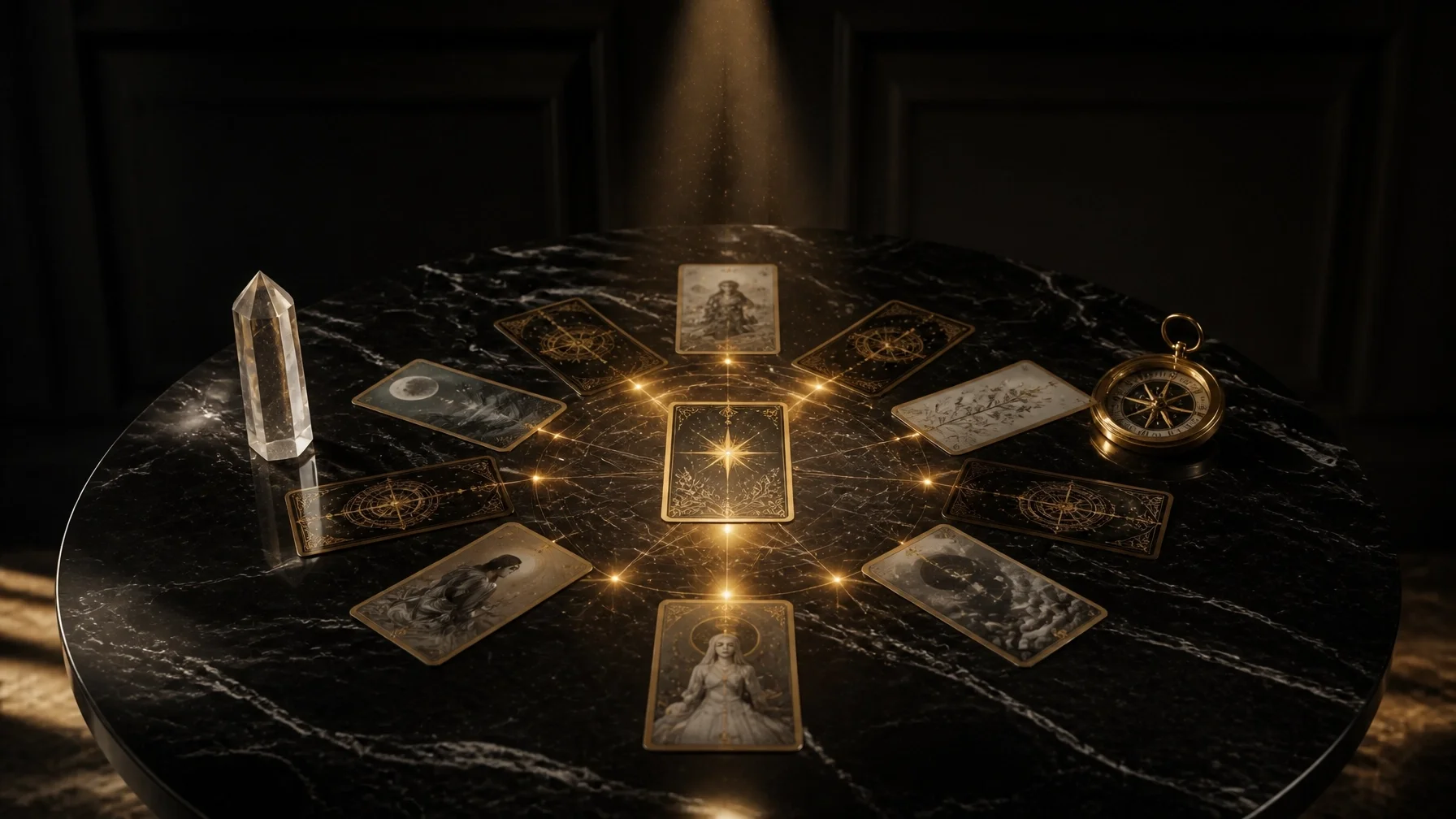
Now comes the part most people think of when they hear the words tarot reading or oracle cards: drawing and reading the cards.
This is where the images become useful: not because they contain unquestionable answers, but because they give your mind something specific to respond to.
A card can interrupt the story you’ve been repeating. It can bring an emotion, assumption, or possibility into view. It can help you notice what you already know but haven’t been willing or able to name.
The card is not the answer by itself. Meaning is created through the relationship between the image, your question, your current circumstances, and your response.
That distinction matters. You remain the person responsible for your choices. The cards are a tool for reflection, not a replacement for your judgment.
Tarot and oracle cards: what’s the difference?
If you’re new to this practice, it’s easy to assume tarot and oracle cards are the same thing. They can be used in similar ways, but they have different structures.
Tarot generally follows a 78-card structure. It includes:
22 Major Arcana cards, which often explore larger life themes, transitions, and archetypal experiences
56 Minor Arcana cards, divided across four suits
A shared framework that makes tarot easier to study across different decks
The artwork, names, and interpretations can vary from one tarot deck to another. However, the underlying structure gives you a consistent system to work with.
Oracle decks don’t follow one universal structure. An oracle deck may contain 20 cards, 44 cards, 60 cards, or another number entirely. It may focus on archetypes, emotions, affirmations, relationships, personal development, or a specific creative world. Some oracle decks are direct and word-based. Others rely more heavily on visual symbolism.
Neither tool is automatically more powerful, more accurate, or more serious.
Choose the tool that supports the question you’re asking and the way you naturally reflect. A structured tarot deck may help you explore complexity. An oracle deck may offer a simpler entry point when you need one clear theme to consider.
You can explore Hello Spirito’s Divinity Tools as physical tools for bringing symbolic reflection into your everyday life.
Drawing the cards: there’s no single correct method
The participant may draw the cards, or the reader may draw them. Both approaches can be appropriate.
When you draw for yourself, the physical act of choosing a card can help you slow down and participate actively in the reflection. When another person draws for you, their role is to hold the structure of the reading and help you examine what comes up.
There’s no need to become anxious about doing it “right.” You don’t need a particular hand, a perfect shuffle, or a special number of times to cut the deck.
What matters more is consent, attention, and context.
If someone else is reading for you, they should reflect what they see, ask thoughtful questions, and interpret responsibly. They shouldn’t claim certainty about your future, pressure you into a decision, or override your understanding of your own life.
A responsible reader might say:
“This image could point to a pattern around control. Does that connect with what’s happening for you?”
An irresponsible reader might say:
“This card proves you need to leave your job immediately.”
The first approach leaves room for your experience and judgment. The second takes your sovereignty away.
When reading for yourself, begin with your own response before opening the guidebook. The guidebook can provide useful structure, but it shouldn’t replace your ability to observe.
Read the image before you read the meaning

When you turn over a card, give yourself a moment before reaching for an interpretation.
Look at the image as if you’re encountering it for the first time. You don’t have to identify every symbol. Start with what is obvious.
Ask yourself:
What do I notice first?
Where does my attention go?
What emotion does this image bring up?
Does my body feel open, tense, heavy, relieved, or uncertain?
What seems to be happening in the scene?
What part of the image feels familiar?
What part do I want to avoid?
Your first response is not automatically the final meaning. It is information.
You may feel irritated by a card because it challenges the identity you’ve been trying to maintain. You may feel relieved because it gives shape to something you’ve already sensed. You may feel nothing at all. That’s also useful to notice.
Try describing the image without interpreting it:
> “I see a figure standing at a doorway. The figure is facing forward, but the room behind them is darker. There are two possible paths.”
Only after you’ve described what you see should you connect it to your situation.
This keeps the reading grounded. Instead of forcing the card to confirm what you already want, you create space for a more honest conversation.
A simple one-card reading process
You don’t need a complicated spread to begin. One card and one clear question are enough.
1. Return to the question
Read your question again. Make sure it’s open-ended and focused on understanding or action.
Useful questions include:
“What do I need to understand about this situation?”
“What pattern am I repeating?”
“What am I not seeing clearly?”
“What is one grounded next step?”
“What support or boundary would help me respond well?”
“What assumption is shaping my current decision?”
Avoid questions that ask the cards to make a decision for you, such as “Will I get the job?” or “Is this person my soulmate?” A yes-or-no prediction may feel appealing, but it usually gives you less room to think clearly.
2. Observe the card
Study the image before consulting the guidebook. Notice the details, your first thoughts, and your emotional or physical response.
3. Describe what you see
Write down the visible facts. Colors, figures, direction, distance, objects, facial expressions, movement, and stillness can all be relevant.
4. Connect it to the situation
Ask where the card’s themes appear in your real life. Is it showing a habit, a fear, a conflict, a resource, or an option?
The card might not describe the outside event. It may describe your role in the event, the lens you’re using, or the response you’re considering.
5. Check the traditional meaning
Now consult your guidebook or trusted tarot reference. Compare the established meaning with your first response.
You don’t have to accept every interpretation. Keep what adds clarity. Set aside what doesn’t fit.
6. Write one grounded action
A useful reading should lead somewhere practical.
Your action might be:
Schedule the conversation you’ve been avoiding
Review the facts before making a decision
Say no to one commitment that is draining your capacity
Ask for specific support
Take a pause before responding
Gather more information instead of acting from fear
Keep the action small enough to complete. Insight without integration can become another form of avoidance.
7. Close the reading
Write one or two sentences summarising what you’re taking from the card. Then put the deck away, take a breath, and return to your day.
The goal isn’t to keep pulling cards until you get the answer you hoped for. Repeatedly drawing cards from anxiety can make your thinking less clear, not more.
How to evaluate an interpretation
Not every interpretation is useful. You’re allowed to question it, disagree with it, or pause before acting.
A strong interpretation should pass four basic tests:
Does it fit the facts?
It should relate to what is actually happening, not just create a dramatic story.Does it create useful clarity?
You should understand something more clearly after the reading: not feel more frightened or dependent.Does it respect safety?
No card should be used to justify harm, coercion, stalking, reckless behaviour, or ignoring professional advice.Does it lead to a practical action?
Even a small action is better than a vague prediction.
Cards are not a substitute for medical, legal, financial, or mental-health professionals. If you’re facing a serious health concern, legal matter, financial decision, or mental-health crisis, seek qualified support.
A tarot or oracle interpretation is a perspective and a prompt for self-reflection. It is not a fixed prophecy. The future is shaped by circumstances, information, relationships, choices, and actions: not by a card drawn on a particular day.

Where cards fit inside Hello Spirito’s work
Hello Spirito does not offer standalone one-on-one card readings.
Within the one-on-one Sovereign Audit, cards may be used as one reflective tool inside a larger process. They are not used to predict your future or make decisions for you.
The work moves through conversation, diagnosis, blueprint, and integration. We look at the systems operating in your life: your boundaries, obligations, relationships, habits, emotional state, and available capacity.
Cards may help bring a pattern into the conversation. They don’t replace the conversation.
They may help you name what feels unclear. They don’t replace diagnosis.
They may offer a useful perspective. They don’t replace the blueprint or the real-world steps required to change your circumstances.
That is the difference between using a symbolic tool responsibly and outsourcing your authority to it.
The purpose of the three-step journey
The first step is conversation and intention.
The second step is cleansing your space and creating a respectful connection with the practice.
The third step is reading the cards with attention, context, and discernment.
Together, these steps create a simple reflective structure. You ask a better question. You create enough calm to hear your own response. Then you use the image to examine your patterns, emotions, assumptions, and options.
The purpose is not to predict your life.
It is to see your life more honestly: and choose your next move with greater clarity.
That is tarot for self-discovery. That is how oracle cards can support personal sovereignty. The cards can open a conversation, but you remain the author of what happens next.
