
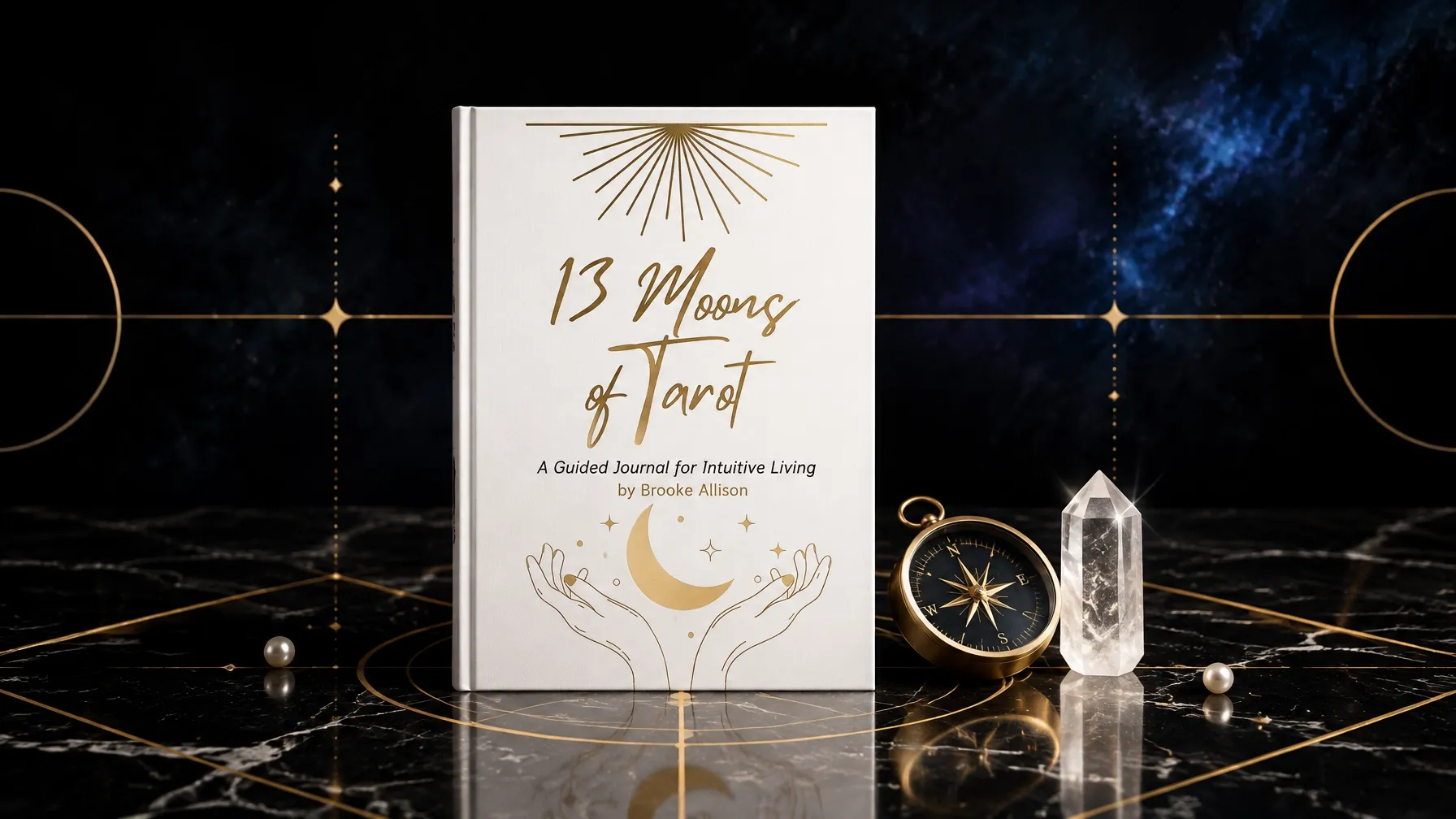
You've made the vision board.
It's beautiful. The colors are right. The apartment, the money, the relationship, the creative life: you can see all of it arranged in one glossy collage.
And then Monday arrives.
Your calendar is full. Your energy is inconsistent. The important email still isn't sent. The boundary is still being negotiated. The project remains a beautiful idea with no operating structure underneath it.
That's the problem with most manifestation practices: they give desire somewhere to look, but not somewhere to go.
A collage can remind you what you want. It can't tell you what changed, what stalled, what you avoided, or what needs to be adjusted next. It doesn't survive contact with a real calendar.
A manifestation practice becomes useful when it produces evidence.
The 13 Moons framework treats manifestation as an architectural outcome you can log, review, and refine. One lunar cycle becomes one chapter of work. Your journal holds the record. Tarot and oracle cards become reflective instruments, not fortune-telling devices, and your decisions remain your own.
Why a vision board isn't a system
A vision board is a snapshot of an outcome. A system is a structure that can carry an outcome through time.
That distinction matters.
A vision board may show you a spacious home, but it doesn't create a housing budget, identify the income gap, or track the conversations required to move. It may show you a thriving business, but it doesn't record which offer you tested, which message connected, or where your capacity broke down.
Without a review loop, the board becomes decoration. There's nothing wrong with beautiful decoration. But decoration isn't infrastructure.
A system needs five things:
- A defined objective
- A time container
- Observable actions
- A record of what happened
- A review process that leads to adjustment
That's what makes the 13 Moons method different. It doesn't ask you to feel as if something has already happened. It asks you to name the result, place it inside a workable period, observe your choices, and tell the truth about the data.
Your emotional state matters. So does your presence, your rapport with other people, and whether your actions are grounded in consent and personal sovereignty. But none of those things should be used to bypass practical reality.
A journal for manifestation should help you meet reality more clearly, not escape it.
What the 13 Moons method actually is: the moon as a unit of work
The method uses thirteen lunar cycles as thirteen chapters of observation and action. Each moon is roughly four weeks, giving you a contained period to work on one meaningful area without turning your entire life into a performance review.
One moon might focus on:
- Stabilizing your finances
- Completing a creative project
- Repairing your relationship with time
- Building a healthier communication pattern
- Creating more space in your home or schedule
The goal isn't to force a huge transformation in twenty-eight days. The goal is to create a clear enough container that you can see what supports movement and what creates friction.
At the beginning of each moon, choose one primary intention and, if appropriate, one or two supporting intentions. Keep them specific. "I want abundance" is difficult to audit. "I will send three qualified proposals and review the response rate by the next new moon" gives you something to work with.
The moon is not being asked to do the work for you. It's providing a recurring review date.
That's the intelligence of the framework: the cycle gives your attention a rhythm, while the journal gives your decisions a memory.
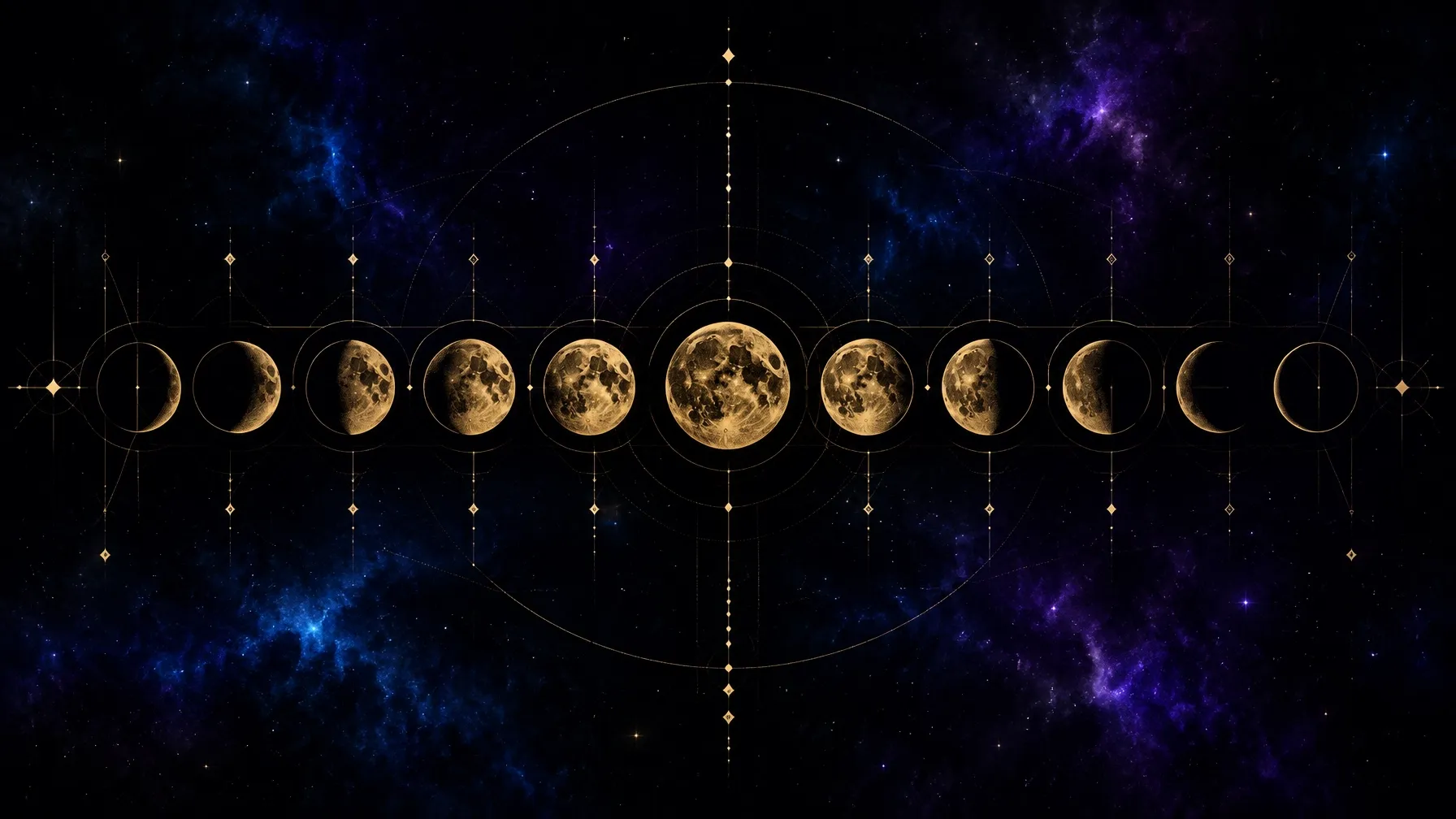
The five-part loop that runs every cycle: Name it · Place it · Pull it · Log it · Review it
Every moon follows the same five-part loop.
1. Name it
Write the result you're working toward in plain language.
Try:
"By the end of this moon, I will have a clear offer, a published sales page, and a record of who responded."
This is not about pretending the result has already arrived. It's about defining what completion would look like.
2. Place it
Give the intention a location in time and in your calendar.
Choose the first action. Schedule the review. Note the likely constraints: travel, caregiving, deadlines, health, money, or limited capacity. A sovereign plan includes the actual conditions of your life.
If your intention requires another person, include their agency in the structure. You can prepare the conversation, make the request, and set your boundary. You can't manufacture their consent or control their response.
3. Pull it
Use a tarot deck or oracle deck to create a reflective pause before you move.
This is where the cards become executive intelligence. They can help you notice assumptions, emotional patterns, missing information, or a decision you've been avoiding. They don't make the decision on your behalf.
A simple three-card tarot spread might be:
- What is the current condition of this intention?
- What practical factor needs my attention?
- What is the next responsible action?
If you're learning how to read tarot, start with the image, your first response, and the position of the card before reaching for a guidebook. Ask: What does this card make visible about my behavior, attention, or options?
4. Log it
Record what actually happened.
Log the date, action, result, emotional state, relevant conversations, and any resistance you noticed. Keep the entry short enough that you'll continue.
A daily oracle pull can support this step. Pull one card with a clear boundary around the practice, then write:
- The card name
- The detail that caught your attention
- One action or observation for the day
- What happened afterward
The point isn't to collect mystical messages. The point is to build a record of how you interpret information and how that interpretation affects your choices.
5. Review it
At the next new moon, stop and assess.
What moved? What didn't? What changed in your emotional state? Which actions created traction? Which actions consumed energy without producing a useful result? What needs to be continued, redesigned, delegated, or released?
This is the step most vision boards don't have.
Setting up your journal so it does the work for you
Your 13 Moons of Tarot Journal is designed to hold this practice as a physical instrument: thirteen lunar chapters, repeated reflection, and enough space for the data to become visible over time.
For each moon, create three layers.
The opening spread
Use the first pages to define:
- The moon's dates
- Your primary intention
- The evidence that would show progress
- The main constraint to account for
- A three-card tarot spread
- The first action you'll schedule
Keep the intention narrow enough to review. A moon can hold meaningful work, but it can't carry every unresolved part of your life at once.

The weekly pages
Once a week, record:
- What I intended to move
- What I actually moved
- Where my attention went instead
- The conversation, boundary, or decision that matters next
- One adjustment for the coming week
You can add a single-card pull here. Keep the question consistent across the four weeks so the entries can be compared. For example: "What deserves practical attention this week?"
The closing review
At the end of the moon, answer:
- What evidence did I produce?
- What result appeared, even if it looked different from the original plan?
- What remained unchanged?
- What did my emotional state reveal about the structure?
- What will I repeat, remove, or redesign next moon?
This isn't a moral judgment. A missed action is information. A delayed result is information. So is the discovery that the goal no longer belongs to you.
Reading your own data instead of your mood
Your mood is real, but it isn't always a reliable reporting system.
On a difficult day, you may decide nothing is working. On an exciting day, you may assume everything is aligned. Neither conclusion is necessarily supported by evidence.
After three or four moons, patterns begin to appear:
- You plan well but don't protect execution time.
- You overcommit during high-energy periods.
- You avoid direct conversations and call the delay "divine timing."
- You make progress when the next action is visible.
- You keep choosing goals that belong to someone else's expectations.
This is where your tarot journal becomes more valuable than a one-time reading. You aren't only interpreting a card in isolation. You're comparing your interpretations with your behavior over time.
You may notice recurring cards, repeated questions, or similar emotional states around the same type of decision. Treat those repetitions as prompts for investigation, not proof of fate.
The cards can open a conversation with your patterns. Your choices still close the loop.
What to do when a moon cycle produces nothing
First, don't turn the lack of visible progress into a character verdict.
Then investigate the structure.
Ask:
- Was the intention specific enough to measure?
- Did I schedule the actions, or only think about them?
- Was the result dependent on someone else's consent or timing?
- Did an unrecorded constraint consume my capacity?
- Did the goal change before I admitted it?
- What did the cycle clarify, even if it didn't deliver the original outcome?
Sometimes "nothing happened" means the plan had no operational support. Sometimes it means the desired outcome wasn't yours. Sometimes the meaningful result was diagnostic: you found the leak.
Your next step may be smaller than the original one. Replace "launch the business" with "complete and send the first offer." Replace "fix the relationship" with "make one clear request and observe the response." Replace "be more confident" with "make the decision without asking five people to authorize it."
The work is not to force a result. The work is to create conditions where an honest result can be seen.
Thirteen moons is a year of evidence
One moon can give you a useful snapshot. Thirteen moons give you a body of evidence.
Across a year, you can see which intentions were sustained, which environments supported you, and which patterns kept repeating. You can distinguish a temporary emotional state from a durable operating problem.
That's why the journal matters as an artifact. A digital note can disappear into a folder. A physical tarot journal remains a visible record of your decisions, interpretations, and revisions. It becomes a map of how you work with your own authority.
The Mystical Realms Oracle Deck can serve as the companion for a daily pull: one card, one observation, one grounded action. Let the image create a moment of presence. Let the record show what you did with that moment.
No vision board is required.
You need a defined cycle, an honest ledger, and the willingness to adjust the architecture when the evidence changes.
Begin with one moon. Name what you're building. Place it on the calendar. Pull a card with consent and intention. Log what happens. Review without flinching.
Then let the next moon receive the truth.
For more of Hello Spirito's divinity tools and lore, visit Hello Spirito.